
The 21st International Conference on Architectural Graphic Expression will be held on May 28, 29, and 30, 2026, in Barcelona, a city designated by UNESCO-UIA as the World Capital of Architecture in 2026.
In this exceptional setting, participants are invited to take part in an event aimed at analyzing the CERTAINTIES present in our field of knowledge in order to explore and confront the UNCERTAINTY generated by current and future processes of architectural ideation and representation.
To this end, the conference is structured in five thematic areas to which we call for papers to be submitted.
- … IN TEACHING AND LEARNING
- … WITH INFORMATION AND DATA
- … OF DRAWINGS, GEOMETRIES, AND STROKES
- … FROM THE EXISTING
- … TOWARDS SOCIETY
The conference will be hosted at the Barcelona School of Architecture (ETSAB) and will include lectures, presentations, roundtables, exhibitions, site visits, and workshops relating to our teaching and research disciplines, as well as events connected to other fields of architecture, society, and innovation.
The Department of Architectural Representation (DRA), present at the ETSAB, ETSAV (Vallès School of Architecture), and EPSEB (School of Building of Barcelona) — all part of the UPC — is organizing the EGA26 Conference.
The DRA encourages the community in the field of architectural representation in both national and international schools to participate with their papers and to attend in person in order to establish new connections, strengthen existing ones, share challenges, and enjoy an atmosphere of exchange among colleagues.
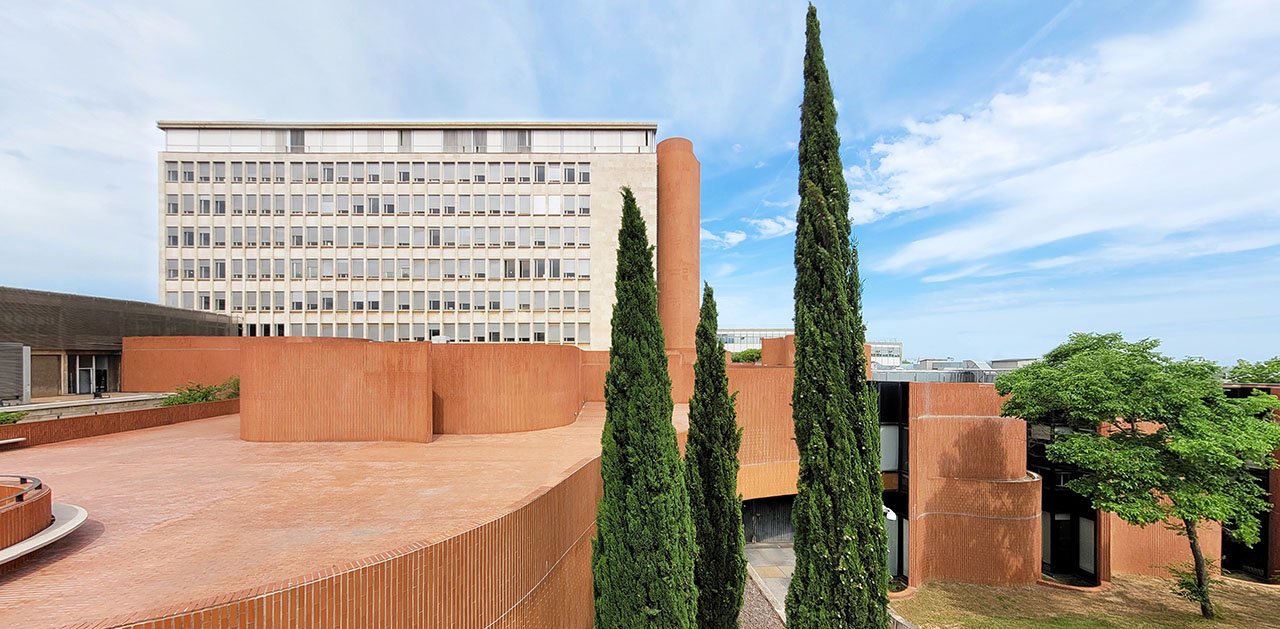
ETSAB, 2025
Certainties
Traditional techniques, geometry, data, reliable information, references.
Uncertainty
Intrinsic to the process of ideation, to architectural design, to the construction of a drawing, to technologies as yet unknown, and to opinions.

If there is something that brings us together in this world of architectural representation, it is the CERTAINTIES offered by traditional techniques, drawing, digital drafting, the narrative of a shared language, the surveying of reality, geometry, and manual linework. We cling to traditions, to what we know and accept as true. Certainties comfort us.
But if there is something else we also share in common—those of us involved in this discipline from which we learn and which we aim to teach—it is UNCERTAINTY. To make architecture means to navigate uncertainty, trial and error, sketching, variations—all manifestations of the uncertain, of that which is not final.
We set out to design, to create, to imagine while looking toward an unknown place, of which the only thing we can be sure is that it will change. In her book El temps de la promesa (Ed. Anagrama, 2023), Marina Garcés writes: “…we say we expect nothing, that we live in uncertain times, that no one knows what will happen or what the next imminent accident or catastrophe will be. And yet, even so, we hope and long for something…”
To be a professor is, by nature, to believe in the future—the future that our students will shape. To teach architecture is to equip students with the tools to create what does not yet exist. To be an architect is to be comfortable with uncertainty.
Whether in the field of surveying architectural heritage, the geometric speculation of form, or computational design, we have entered a phase where we are forced to work between certainty and uncertainty. We have not yet defined what the certainties are, what is reliable and can support our proposals. Nor have we clearly identified the unpredictable—but it is clear that we must acknowledge, in our practice, that the paths we follow are highly uncertain.
It seems reasonable to question the value of new technologies, and it would be unwise to adopt them blindly. But the university cannot avoid the discussion. We must take a stance so that the integration of the new serves to maintain—and, if possible, enhance—the quality of architecture. This means that such change must represent progress, not regression, in the training of future architects. We must find the positions from which to work. What we cannot afford are prejudices or preconceptions.
We find ourselves, then, at the perfect crossroads: aiming to find the tools to discard, affirm, or consolidate certainties, to put information in its place, and to turn uncertainty into a crack through which creativity can emerge.
EGA26 aims to be a collective sharing of what each individual or group has researched, tested, questioned, or discarded through their work in architectural representation. We propose a platform from which we can explain and listen to one another, and from which we can move forward into the next phase.